
A plethora of articles exist out there comparing a custom website vs. a template. Which is cheaper? Which is faster? Which is better for SEO? Which is right for your business?
But if you’ve already decided you want custom web design, there’s another question worth asking: how do you know you’re actually getting it?
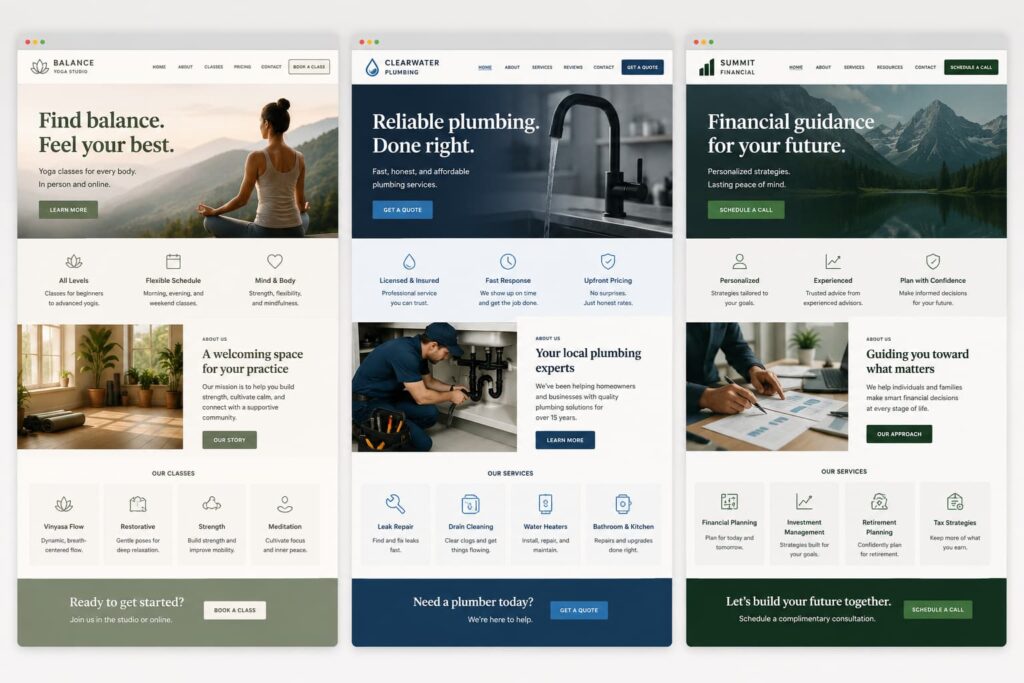
I started thinking about this recently while looking through other web designers’ portfolios. I noticed that in some of them, the websites looked suspiciously similar. Different businesses. Different logos. Different colours and photos. Same basic website. Same curved hero section, same logo placement, etc.
I’m not suggesting those clients were ripped off. I don’t know what they paid, what they asked for, or what the designer promised them. A straightforward template-based website may have been exactly what they wanted.
But it did make me wonder how a small business owner who doesn’t work in web design is supposed to evaluate the word “custom.”
What does custom web design actually mean?
The problem is that custom isn’t really binary. A website isn’t necessarily either a completely untouched template or a bespoke design built from a blank canvas.
There’s a lot of space in between.
At one end, a web designer or developer might start with a website template and swap in the client’s logo, brand colours, fonts, imagery, and content. The underlying page structure and layouts stay mostly the same.
That’s a form of customization. The visual branding has been customized for the business.
A designer might take that further by applying a complete brand design system to the template. Typography, colour, imagery, buttons, cards, spacing, iconography, and other visual elements may all be changed. By the time they’re finished, the site might look very different from the original template even if some of the underlying page structures are still there.
Then there’s structural customization. Pages are reorganized or rebuilt. Content hierarchy changes. Navigation and information architecture are reconsidered. New sections are designed because the existing ones don’t work for the content. User pathways and conversion points are built around what people actually need to do on the website.
And sometimes a business needs completely custom pages, functionality, or user experiences because the template simply wasn’t designed to solve that particular problem.
All of these approaches can involve custom website design. But they’re not the same type or amount of custom work.
So the more useful question might be: what is actually being customized?
Templates come with assumptions
I use website templates. Most web designers and developers don’t need to reinvent the wheel for every project.
A template can give you a solid starting structure, reusable components, responsive layouts, and established design patterns. If I need a hero section with a headline, a paragraph, and a button, I do not need to retreat to a cabin in the woods and spend three days inventing a new way to arrange those things.
But templates also come with assumptions.
They assume a certain type and amount of content. They assume a certain page structure. They make decisions about hierarchy and how users will move through the website. Often, they were designed with a particular type of business in mind.
Sometimes those assumptions fit.
A straightforward service business may need a home page, an about page, service pages, and a clear way to get in touch. A well-chosen website template may provide an excellent starting point. Apply the business’s brand, add its content, make the necessary adjustments, and you may have exactly the website that business needs.
Sometimes, though, the assumptions fall apart as soon as you get into the actual project.
When the template stops fitting the business
I’m currently designing a new website for Green Mary, sustainable event waste management company in the San Francisco Bay Area.
When I started the project, I had already modernized Green Mary’s visual idententity and developed a design system for the new site. I had hoped I could find a template that would get us a lot of the way of the way there, apply Green Mary’s design system and save some design and development time.
Then I started working through the business itself.
Green Mary helps event planners reduce waste through planning, on-site waste stations and staff, sorting, repurposing, and impact reporting. Their clients range from corporate conferences and athletic events to weddings, festivals, and wineries. However, do not “buy” separate, stand alone services through Green Mary, so they did not fit a typical waste management service template.
The website needed to help different types of event organizers find the information relevant to them. It needed to explain a service people may not immediately understand. It needed to show Green Mary’s process, communicate the company’s impact, and create clear paths toward requesting a quote.
Green Mary isn’t a standard waste management company. They are a niche B2B business that needed custom business solutions that a template wasn’t going fully provide.
At that point, it became a structural starting point rather than a solution. In Figma, I designed four custom pages around Green Mary’s specific content, business goals, and user needs. For the remaining pages, I’m using the template where its structure works and applying Green Mary’s design system so the entire website belongs to the same visual world.
That’s how I think templates should work. They can save time. They can provide useful building blocks. But when the business needs something the template wasn’t designed to do, the website needs to change—not the business.
Not every business needs the same level of customization
Just so I’m clear, there’s nothing wrong with a template swap.
If your budget is limited and a well-chosen template already fits your business, swapping in your branding, imagery, and content may be a perfectly reasonable way to get a professional website online.
I’ve used a template for my own business website. At this point I’ve customized it so heavily that most of the pages are custom, but the template gave me a framework and helped me get the site up and running quickly.
The amount of custom web design a business needs depends on the business, the website’s goals, the content, the users, and the budget.
A template swap should also be priced like a template swap. A customized template involves more design work. Custom page layouts, information architecture, user experience design, and specialized functionality involve more again.
Those are different services.
If you’re happy paying less for an existing website template with your brand applied to it, great. You should simply know that’s what you’re buying.
Look at the designer’s portfolio
If you’re hiring a web designer and paying for custom web design, spend some time looking through their web design portfolio.
Don’t just ask whether the websites look good.
Look at several projects side by side. Do completely different businesses somehow have the same page structure? The same hero layout? The same rows of cards? The same content patterns in the same order?
Different colours, fonts, and photos can make the same underlying template look surprisingly different at first glance.
Then ask the designer about their process.
Do they start with a template? What do they customize? How do they decide on the page structure? What happens if the template doesn’t fit your content or your business needs?
There isn’t one correct answer to those questions. A designer who uses templates isn’t automatically offering an inferior service, and a completely custom website isn’t automatically the right solution for every business.
The point is to understand what you’re paying for.
Because if you’re paying for custom web design, you should know how custom your custom website actually is.